

As the transition to green hydrogen accelerates, one challenge is becoming increasingly clear: securing sufficient water without adding pressure to already strained freshwater resources. By rethinking how industrial water streams are treated and reused, new opportunities are emerging to support hydrogen production in a more sustainable and resource-efficient way.
A promising and sustainable alternative water source
As global water scarcity intensifies and hydrogen demand is expected to rise sharply by 2050, relying on drinking water for electrolysis risks exacerbating competition between water, food, and energy needs. Hydrogen production requires significant volumes of high-quality water, making alternative feedstock sources essential.
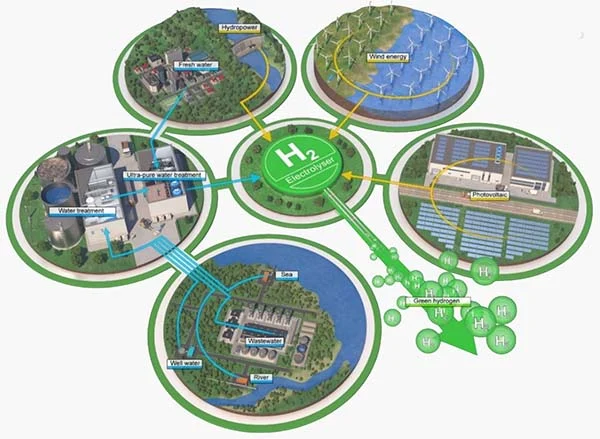
Figure: Integration of industrial wastewater and other feedstock water sources into a holistic approach for hydrogen production
In the PDF-article linked here below you can read that industrial wastewater – ranging from low-polluted mine water and surface water to vapor condensates and highly contaminated food-processing effluents can be effectively treated and reused for hydrogen production.
Through a combination of advanced technologies such as ozone-assisted ceramic ultra filtration, biological treatment, anaerobic digestion, ultrafiltration, and reverse osmosis, wastewater can be converted into water that meets electrolyser or even drinking water standards.
Biological
(MBBR) >
Ultra-
filtration >
UV-disinfection >
RO*
(η=65–85%) >
*Reverse Osmosis
Flow diagram of the treatment strategy for treating organically low-polluted streams to drinking water quality.
Treatment of inorganically low-polluted streams, e.g. mine water or surface water
Low-polluted mine wastewater can be efficiently treated using a multi-stage process that combines pre-filtration, ozone dosing, ceramic ultrafiltration, activated carbon filtration, and reverse osmosis.
At the core of this approach is ceramic membrane filtration enhanced by upstream ozone treatment. The ozone breaks down organic contaminants and significantly reduces membrane fouling, improving performance and extending membrane service life. Marketed as CembrOzone, this integrated solution ensures reliable water quality, with activated carbon removing residual ozone before final polishing by reverse osmosis.
CembrOzone:
AOP + Ceramic Ultrafiltration
Pre-
filtration >
AOP
(ozone) >
Ceramic Ultrafiltration >
AC (for ozone destruction) >
Reverse
Osmosis >
Flow diagram of the CembrOzone solution
Learn more
- Read the full and detailed article Industrial wastewater as an alternative source for the production of hydrogen from EnviroChemie.
- Product information – CembrOzone
Get in touch with us to learn more about what we can do for you!
Mattias Holm
Sales
+46 (0)703 19 04 03
mattias.holm@enwa.com